
Virtual reality for medical training
Virtual Reality in Healthcare
Transforming medical education through immersive virtual reality solutions
Through life-like simulations and immersive training experiences, virtual reality technology has revolutionized healthcare education and training with transformative solutions.
We help healthcare organizations optimize their learning processes, amplify training efficiency, and harness the full power of VR to set a new standard in medical education.
Industry Outlook
The growing adoption and future of VR in medical training
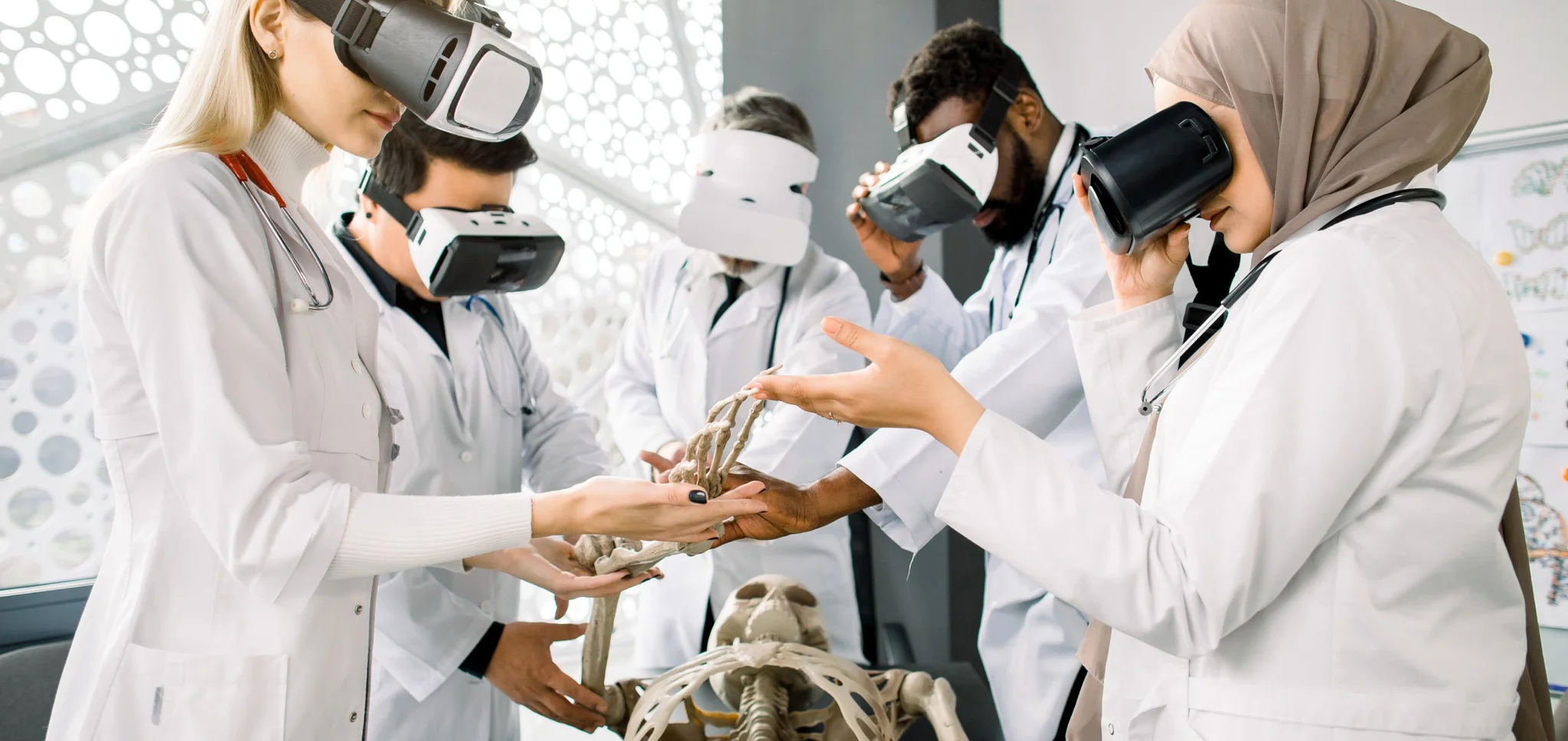
Medical schools and teaching hospitals around the world have embraced virtual reality in education to train students, doctors, and healthcare practitioners in safe, immersive environments.
Governments and institutions continue to support initiatives that increase the availability of advanced VR medical products and services across healthcare sectors globally.

Key Use Cases
Core focus areas for VR in medical training
Virtual reality training in medical education opens enhancements across multiple specialized clinical directions and operational workflows.
- Anatomy exploration with detailed 3D spatial models
- Procedural rehearsals for routine and complex surgeries
- Emergency management and high-pressure decision making
- Patient interactions and clinical communication skills
- Multidisciplinary team collaboration in virtual environments

Everything you need to know about building medical VR training software
Whether mastering intricate procedures or preparing for critical emergencies, VR offers medical students and practitioners a safe environment to gain hands-on experience.
Immersive virtual reality closely replicates real-world scenarios, bridging the gap between theory and practice. Trainees can visualize and manipulate highly detailed 3D models of vessels, bones, organs, and tumors, supported by realistic equipment models and haptic feedback.
Well-designed VR apps include tools to track user actions, movements, and decision-making during virtual procedures. This data supports objective evaluations, detailed feedback, and personalized guidance to help users improve skills efficiently.

Compliance and Anatomical Accuracy
If your VR medical training app processes protected health information, development teams must incorporate robust security measures aligned with HIPAA and GDPR privacy regulations. Achieving precise anatomical accuracy is a core challenge, requiring close collaboration with medical professionals to validate every detail of human anatomy and clinical procedures.
Key Benefits of VR Training
Immersive Realism
Replicate real-world clinical scenarios and manipulate detailed 3D anatomical models with high fidelity.
Safe Environments
Hone critical decision-making and experience rare medical situations in a controlled, risk-free setting.
Cost Efficiency
Eliminate expensive single-use training equipment and biological models with reusable software applications.
Remote Accessibility
Enable students and practitioners to practice from any convenient location, broadening access to education.
Measurable Analytics
Track user actions and performance metrics to support objective evaluations and personalized guidance.
VR App Tier Comparison
Explore sample features and architectural scopes across different complexity levels for medical VR software.
| Category | Basic App | Mid-Level App | Complex App |
|---|---|---|---|
| Visual Models | Simple models with basic textures | Moderate detail with realistic textures | High realism with dynamic lighting |
| Scenario Logic | Single training scenario | Predefined paths, multiple scenarios | Adaptive learning paths based on data |
| Interactivity | Moving objects and simple clicks | Physics-based interactions and cues | Highly interactive multi-angle manipulation |
| Analytics | Minimal or basic tracking | Completion time and accuracy | Interactive and intuitive user charts |
FAQs

What medical specialties benefit most from VR training?
VR training provides significant value across numerous specialties, including surgery, emergency medicine, cardiology, anesthesiology, orthopedics, neonatology, psychiatry, radiology, and nursing, by allowing safe repetition of complex and high-stakes procedures.
How does VR reduce training costs over time?
While initial development requires investment, VR removes the recurring expenses of single-use medical consumables, animal models, and physical venue rentals. Applications can be reused indefinitely by multiple trainees simultaneously.
What core technologies are used to build medical VR apps?
Medical VR applications typically rely on game engines like Unity or Unreal Engine, 3D modeling tools such as Blender and Autodesk Maya, specialized VR SDKs, and hardware platforms like Meta Quest or HTC Vive.
How is patient data privacy and regulatory compliance handled?
Applications that transmit or store protected health information must adhere strictly to healthcare regulations such as HIPAA and GDPR, utilizing secure authentication, encrypted data transmission, and protected cloud infrastructure.
Can VR training apps integrate with existing hospital systems?
Yes, custom VR solutions can be integrated with learning management systems, electronic health records, medical imaging software, and institutional databases to streamline educational workflows.
How do you ensure anatomical and clinical accuracy in VR?
Accuracy is achieved by partnering with experienced medical professionals and subject matter experts who validate 3D models, procedural workflows, and clinical decision trees during the development lifecycle.
get in touch
Let's Start a Conversation
Have a project in mind? We'd love to hear about it. Fill out the form and our team will get back to you within 24 hours.
Address
1563 McClure Woodland ca 95776
John@digitalgrowthlab.org
Phone
+1 7866924887
Response Time
Within 24 hours